Monthly Archives: May 2017


Do pharmaceutical reps really influence doctors’ prescribing?

From http://noadvertisingplease.org

Yes, the evidence shows that they do.

So, I’ve taken the pledge :

The No Advertising Please Pledge

I believe, with the wide availability of independent medication information, I do not require promotional material from visiting sales representatives from pharmaceutical companies (‘Drug Reps’). The primary role of the Drug Rep is marketing: encouraging doctors to prescribe their company’s medications. This conflicts with my role to provide the best evidence-based treatment and independent advice to my patients. I therefore take this ‘No Advertising Please’ pledge and choose not to see Drug Reps at my practice for one year.

It seems highly unlikely that pharmaceutical companies would spend so much money on promoting their products to doctors via pharmaceutical reps – more than US$6 billion annually in the USA – if reps were ineffective. It would also be irresponsible to their shareholders to spend money in this way. Unfortunately for those of us outside the pharmaceutical industry, we don’t get to see much of the industry’s data on the effectiveness of promotion.

We don’t see the data, but the companies do. We know that the profit from each rep must outweigh their total annual cost: salary, vehicle, training, gifts and other add-on costs. And we know the rep’s only method of making a profit is to influence what flows out of the doctor’s prescription printer.

Specifically, the profit comes from the extra volume of company products the doctor prescribes after seeing the rep, compared to the volume they would have prescribed anyway if they had not seen the rep. If this difference was nil or minimal (as many doctors claim would be their own case), all drug rep jobs would have vanished long ago. In fact, the after-costs profit from these extra scripts presumably totals more than $6 billion annually in the US, or the pharmaceutical industry needs some new accountants!

Many researchers have tried to study direct examples of whether promotion is linked to prescribing changes, and whether these prescribing differences are good or bad. In 2010, Geoff Spurling and colleagues did a systematic review of all such available studies looking at the provision of information from pharmaceutical companies and doctors’ prescribing. This included pharmaceutical reps, print advertising, meeting sponsorship and so on. They found that promotional information was not always linked to changes in prescribing, but when it was, it was almost always associated with more prescribing, lower quality prescribing, and more expensive prescribing. (Spurling)

Better information is readily available!

In Australia, NPS Medicinewise is a well-resourced, independent body which offers practical tools and evidence-based resources on various therapeutic topics to support quality use of medicines and medical tests. It provides extensive, free online resources and decision-making tools for health professionals. NPS also provides free facilitator visits to medical practices, which we recommend as an excellent alternative to visiting pharmaceutical reps.

Rather than focusing on just one drug—let alone just one brand of one drug—the NPS facilitators and resources compare the various available treatments for a particular disease or symptom. This ‘evidence-based comparison’ approach offers a far better basis for balanced clinical decisions than does a series of marketing visits and leaflets advocating the benefits of each individual medicine brand.

For the same reason,  the Australian Medicines Handbook – is a practical, reliable, comparative medicines information resource. Again, the availability of this time-saving, independent resource provides a counter argument to doctors who claim they must obtain a ‘balanced’ view by seeing all the drug reps from rival companies.

The Australian Therapeutic Guidelines prides itself on publishing independent, unbiased and objective information about medications. They have no sponsors, advertisers or shareholders, and maintain strict and transparent conflict of interest guidelines. The Therapeutic Guidelines series covers fifteen topics, with advice about the use of nearly every therapeutic medication most doctors would ever use.

The product information (PI) for every drug approved by the TGA is readily available online, just a couple of mouse-clicks away. The PI has been written by the pharmaceutical company, and provides the scientific basis for all the clinical claims allowed to be discussed by their pharmaceutical representatives.

There are many other good sources of medication information online published by government bodies and hospitals (e.g. Melbourne’s Royal Children’s Hospital handbook and pharmacopoeia), and it is important to look for those that are more independent, and transparent about potential conflicts of interest. Independence is not all-or-nothing, and some judgement is called for when comparing sources. However, to put this into perspective, remember that visiting pharmaceutical representatives, by definition, have substantive conflicts of interest and are never independent.

Feeling groggy? It’s not just the anaesthetic…

Drs Kate Leslie and Megan Allen wrote a recent piece in “The Conversation” about why you might not feel yourself after an operation – together with some prevention tips:

https://theconversation.com/health-check-why-can-you-feel-groggy-days-after-an-operation-74989?utm_medium=email&utm_campaign=The Weekend Conversation - 74165694&utm_content=The Weekend Conversation - 74165694+CID_3e6c28eecd8fe62b89326fa787993c9f&utm_source=campaign_monitor&utm_term=Health Check why can you feel groggy days after an operation

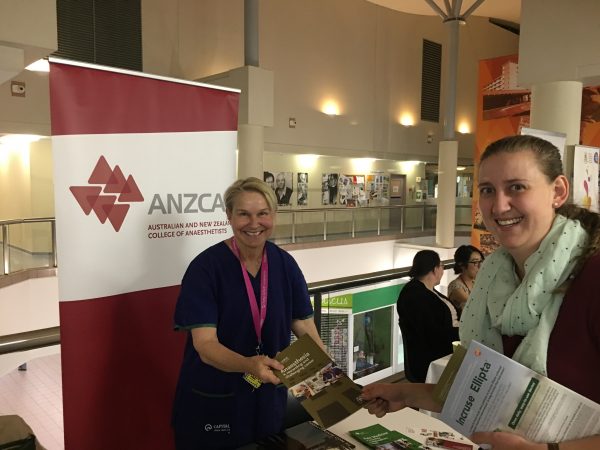
ANAESTHESIA at the Medical Careers Expo

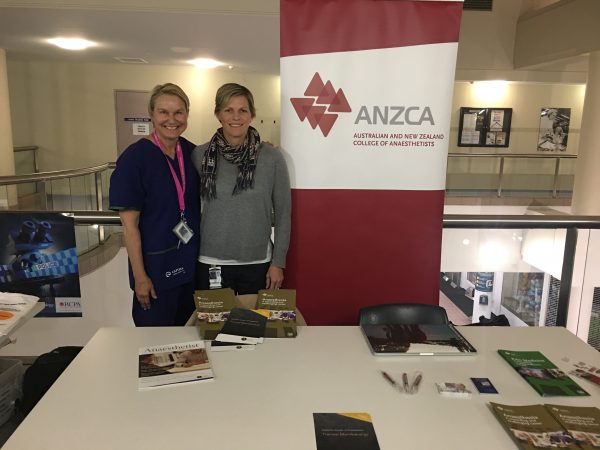
The Medical Careers expo at The Canberra hospital last week was a opportunity to showcase the range of career opportunities that an anaesthesia Fellowship offers – slideshow below…

Vida Viliunas and Julia Hoy at the Careers expo May 2017


https://vimeo.com/218244883

AMA CAREER ADVICE HUB


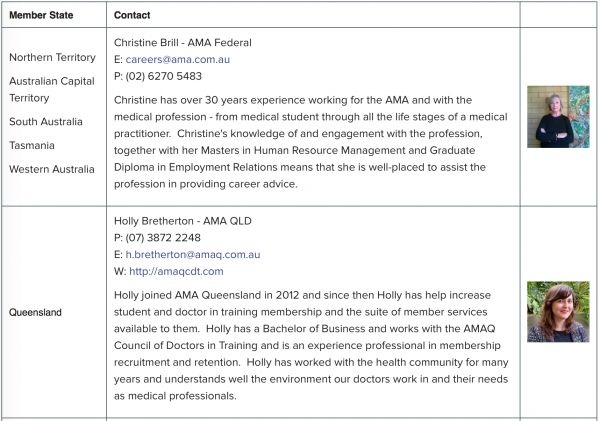
Christine Brill is the AMA’s Federal Career adviser for the AMA Career Advice Hub.

The AMA Career Advice Hub has been developed to provide  advice, support and guidance for those planning medical careers.

The Career Advice Hub is for high school and college students, medical students, new medical graduates, pre-vocational and vocational trainees, qualified practitioners and international medical students and graduates.

There are handy sections for CV presentation and polishing and tips on job interview technique, self-care and financial advice – just what anaesthetic registrars will be needing after their exams….

Have a closer look at https://ama.com.au/careers!

The AMA’s Career Advice service and Resource Hub are there to assist!  Contact the AMA Career Adviser (Christine) on careers@ama.com.au or contact the State or Territory AMA advisers listed below for details on their one-to-one career advisory services. (The links below are not active).

A “Conversation” about anaesthesia…


A recent article in the Health and Medicine section of The Conversation website:

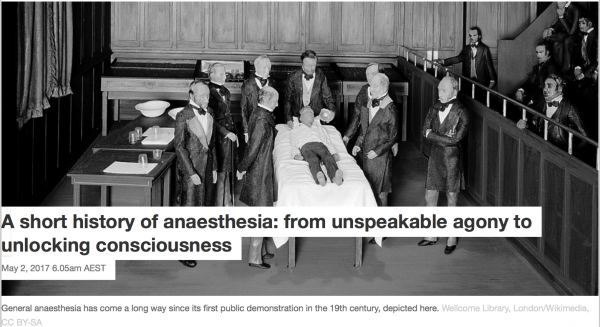
https://theconversation.com/a-short-history-of-anaesthesia-from-unspeakable-agony-to-unlocking-consciousness-74748?utm_medium=email&utm_campaign=Latest from The Conversation for May 2 2017 - 72895553&utm_content=Latest from The Conversation for May 2 2017 - 72895553+CID_67e04e15f258af049914043ee1254fff&utm_source=campaign_monitor&utm_term=A short history of anaesthesia from unspeakable agony to unlocking consciousness

Author David Liley Professor, Centre for Human Psychopharmacology, Swinburne University of Technology

We expect to feel no pain during surgery or at least to have no memory of the procedure. But it wasn’t always so.

Until the discovery of general anaesthesia in the middle of the 19th century, surgery was performed only as a last and desperate resort. Conscious and without pain relief, it was beset with unimaginable terror, unspeakable agony and considerable risk.

Not surprisingly, few chose to write about their experience in case it reawakened suppressed memories of a necessary torture.

 One of the most well-known and vivid records of this “terror that surpasses all description”

was by Fanny Burney, a popular English novelist, who on the morning of September 30, 1811 eventually submitted to having a mastectomy:

When the dreadful steel was plunged into the breast … I needed no injunctions not to restrain my cries. I began a scream that lasted unintermittently during the whole time of the incision … so excruciating was the agony … I then felt the Knife [rack]ling against the breast bone – scraping it.

But it wasn’t only the patient who suffered. Surgeons too had to endure considerable anxiety and distress.

John Abernethy, a surgeon at London’s St Bartholomew’s Hospital at the turn of the 19th century, described walking to the operating room as like “going to a hanging” and was sometimes known to shed tears and vomit after a particularly gruesome operation.

Discovery of anaesthesia

It was against this background that general anaesthesia was discovered.

A young US dentist named William Morton, spurred on by the business opportunities afforded by technical advances in artificial teeth, doggedly searched for a surefire way to relieve pain and boost dental profits.

His efforts were soon rewarded. He discovered when he or small animals inhaled sulfuric ether (now known as ethyl ether or simply ether) they passed out and became unresponsive.

A few months after this discovery, on October 16, 1846 and with much showmanship, Morton anaesthetised a young male patient in a public demonstration at Massachusetts General Hospital.

The hospital’s chief surgeon then removed a tumour on the left side of the jaw. This occurred without the patient apparently moving or complaining, much to the surgeon’s and audience’s great surprise.

So began the story of general anaesthesia, which for good reason is now widely regarded as one of the greatest discoveries of all time.

Anaesthesia used routinely

News of ether’s remarkable properties spread rapidly across the Atlantic to Britain, ultimately stimu- lating the discovery of chloroform, a volatile general anaesthetic.

According to its discoverer, James Simpson, it had none of ether’s “inconveniences and objections” – a pungent odour, irritation of throat and nasal passages and a perplexing initial phase of physical agitation instead of the more desirable suppression of all behaviour.

Chloroform subsequently became the most commonly used general anaesthetic in British surgical and dental anaesthetic practice, mainly due to the founding father of scientific anaesthesia John Snow, but remained non-essential to the practice of most doctors.

This changed after Snow gave Queen Victoria chloroform during the birth of her eighth child, Prince Leopold. The publicity that followed made anaesthesia more acceptable and demand increased, whether during childbirth or for other reasons.

By the end of the 19th century, anaesthesia was commonplace, arguably becoming the first example in which medical practice was backed by emerging scientific developments.

Anaesthesia is safe

Today, sulfuric ether and chloroform have been replaced by much safer and more effective agents such as sevoflurane and isoflurane.

Ether was highly flammable so could not be used with electrocautery (which involves an electrical current being passed through a probe to stem blood flow or cut tissue) or when monitoring patients electronically. And chloroform was associated with an unacceptably high rate of deaths, mainly due to cardiac arrest (when the heart stops beating).

The practice of general anaesthesia has now evolved to the point that it is among the safest of all major routine medical procedures. For around 300,000 fit and healthy people having elective medical procedures, one person dies due to anaesthesia.

Despite the increasing clinical effectiveness with which anaesthesia has been administered for over the past 170 years, and its scientific and technical foundations, we still have only the vaguest idea about how anaesthetics produce a state of unconsciousness.

Anaesthesia remains a mystery

General anaesthesia needs patients to be immobile, pain free and unconscious. Of these, unconsciousness is the most difficult to define and measure.

For example, not responding to, or then not remembering, some event (such as the voice of the anaesthetist or the moment of surgical incision), while clinically useful, is not enough to decisively determine whether someone is or was unconscious.

This chloroform inhaler was the type John Snow used on Queen Victoria to ease the pain of childbirth. Chloroform vapours were delivered down a tube via the brass and velvet face mask. Science Museum, London/Wellcome Images/Wikimedia, CC BY-SA

We need some other way to define consciousness and to understand its disruption by the biological actions of general anaesthetics.

Early in the 20th century, we thought anaesthetics worked by dissolving into the fatty parts of the outside of brain cells (the cell membrane) and interfering with the way they worked.

But we now know anaesthetics directly affect the behaviour of a wide variety of proteins necessary to support the activity of neurones (nerve cells) and their coordinated behaviour.

For this reason the only way to develop an integrated understanding of the effects of these multiple, and individually insufficient, neuronal protein targets is by developing testable, mathematically formulated theories.

These theories need to not only describe how consciousness emerges from brain activity but to also explain how this brain activity is affected by the multiple targets of anaesthetic action.

Despite the tremendous advances in the science of anaesthesia, after almost 200 years we are still waiting for such a theory.

Until then we are still looking for the missing link between the physical substance of our brain and the subjective content of our minds.